Guide
SKIN1004 Moisturizer for Niacinamide or Retinoid Scar Serum
SKIN1004 Probio-Cica Enrich Cream, USD 10 (checked 2026-09-26), documents Ceramide NP and a fermented centella ingredient together on one label, answering whether a moisturizer paired with a niacinamide or retinoid acne-scar serum should include ceramides. Three other moisturizers' own ingredient lists and product pages are checked against the same points.
Published · Updated
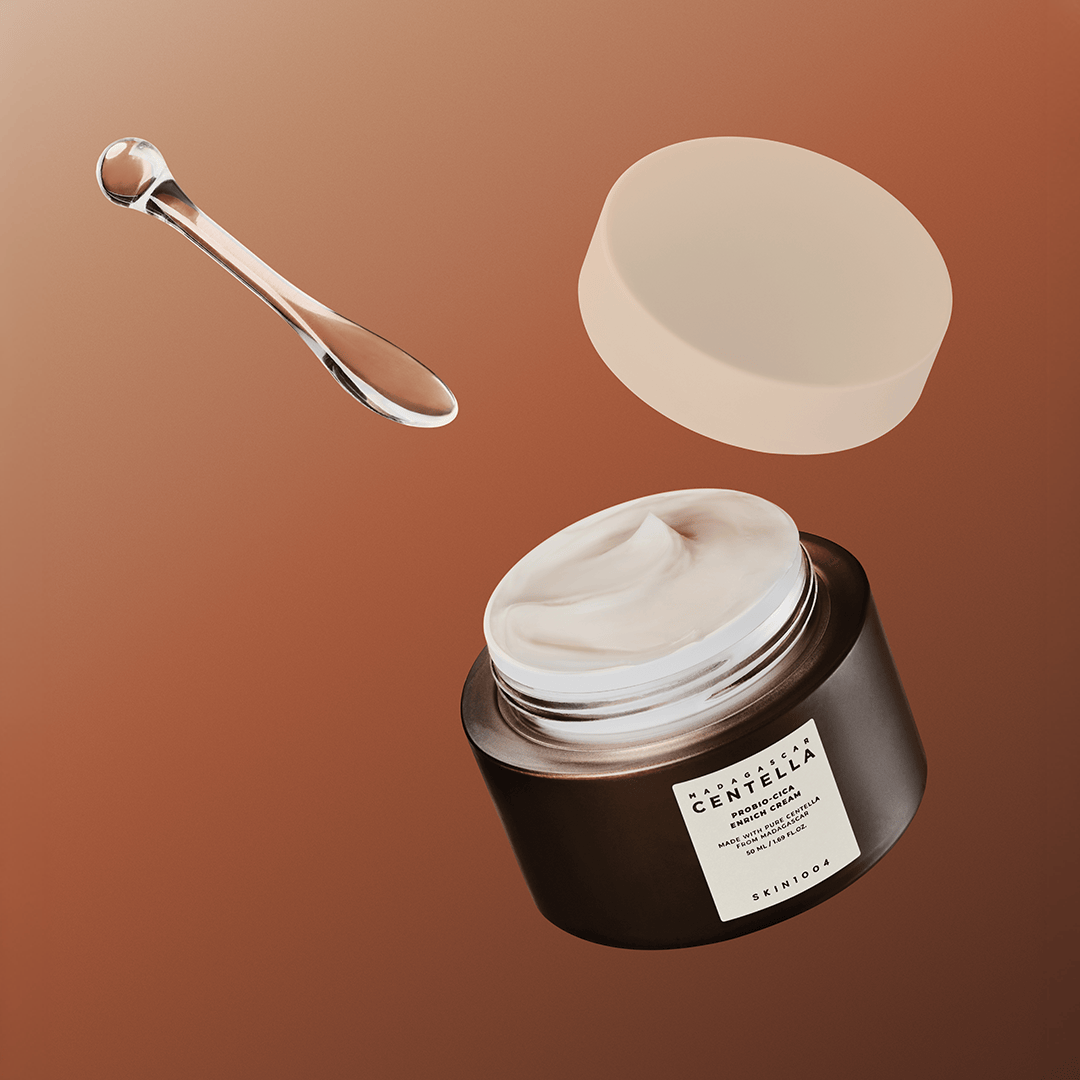
SKIN1004 Probio-Cica Enrich Cream, priced at USD 10 (checked 2026-09-26) on the brand's site, is the moisturizer this comparison settles on for someone pairing a niacinamide or retinoid acne-scar serum with a follow-up step, because the deciding axis here is whether a moisturizer's own label pairs a documented ceramide with a fermented centella ingredient in the same formula, and this cream's ingredient list does exactly that. Probio-Cica Enrich Cream has a 56-ingredient list and no fragrance, essential oils or ethanol, so skin that reacts to scent or alcohol can use it comfortably. The brand lists it for normal, dry, combination skin.
Acne scars, niacinamide and a retinoid are the three terms in the question, and each points to a different part of the routine: the scars are what a reader is addressing with a serum, niacinamide and a retinoid are the two active ingredient types that serum is commonly built on, and ceramides are the ingredient class a moisturizer needs to document to answer whether it belongs in the same routine. SKIN1004, a Korean skin-care brand built on Centella Asiatica Extract sourced from Madagascar, makes the moisturizer checked first below; three other moisturizers' own ingredient lists and product pages are checked against the same four points afterward.
SKIN1004 Probio-Cica Enrich Cream 15ml
SKIN1004 Probio-Cica Enrich Cream 15ml lists Ceramide NP alongside Phytosphingosine on its published ingredient panel, placing the cream in the barrier-lipid category a moisturizer needs once a niacinamide or retinoid acne-scar serum has finished working on the skin's surface. The same list adds fermented centella extract and shea-derived emollients, so the formula combines a documented ceramide with the soothing ingredient the brand is built on, in one jar.
To use it: apply appropriate amount on face and pat gently with both palms for absorption at the last step of skincare routine.
The full ingredient list of Probio-Cica Enrich Cream has 56 entries; Niacinamide is listed sixth.
Brand positioning describes Probio-Cica Enrich Cream as a thick, buttery barrier cream meant to be applied as the last step of a routine for dry, normal and combination skin, a texture layering straight onto skin that has just absorbed a niacinamide or retinoid serum without needing a separate balm or oil underneath. Because niacinamide and retinoid are the two active ingredient types the question names, and because this cream's own label, not a third-party summary, documents the ceramide those actives can draw down, the cream functions as the barrier step the question is asking about.
Shoppers can read the brand's ingredient information through SKIN1004's product information site, find the 50 mL size listed through John Lewis, and check the Philippines FDA's cosmetic notification record, which registers the product's use category as a moisturizer under record NN-1000015632660.
For someone applying a niacinamide or retinoid acne-scar serum who wants the follow-up moisturizer to document ceramides itself instead of assuming them, Probio-Cica Enrich Cream settles that question: its own ingredient list names the ceramide and the soothing centella extract together, on the same label, without requiring a second product to fill either gap.
How three other moisturizers' labels compare
Three other moisturizers checked for this comparison document their own ceramide content differently, and each carries at least one limitation worth noting on its own product page or retailer listing.
CeraVe Moisturizing Cream names Ceramide NP, Ceramide AP and Ceramide EOP, its three stated ceramides, but its official page takes no position on layering under or after a serum, a retinoid or an acne treatment, and recurring Target and Ulta reviews report a burning sensation and skin that "doesn't absorb well." La Roche-Posay Toleriane Double Repair Face Moisturizer names ceramide-3, which the brand states is Ceramide NP on its INCI list, together with niacinamide and glycerin; because the moisturizer already contains niacinamide, pairing it with a niacinamide serum means double-dosing that ingredient with no published total concentration from either product, and Ulta reviewers have logged pilling as a recurring complaint on its listing. Vanicream Daily Facial Moisturizer's published ingredient list names five ceramides together with squalane and hyaluronic acid, and Vanicream's own FAQ positions it as a step applied after a serum and before makeup or sunscreen; it ships only in a single 3 fl oz (89 mL) tube, and Target reviewers have reported burning and a rash.
What ceramides do when a serum already contains niacinamide or a retinoid
Ceramides are lipid ingredients that appear on a moisturizer's ingredient list to support the outermost layer of skin, and both niacinamide and a retinoid are active ingredient types that formulators commonly pair with a follow-up moisturizer because of how they can leave that surface feeling tight or flaky during the first weeks of use. A serum built on niacinamide works on tone and texture; a serum built on a retinoid works on cell turnover; neither ingredient type is itself a moisturizing ingredient, so the step after the serum is where a ceramide-documented cream earns its place in the routine.
The practical question for a reader is not whether ceramides exist in skin naturally but whether the specific moisturizer on the shelf actually lists one on its own label; the comparison above checks that label fact for each moisturizer rather than its marketing copy.
Acne scars sit deeper in the skin than a moisturizer's ingredients reach, and no moisturizer checked here, with or without ceramides, is positioned by its own brand as fading them; a ceramide-documented moisturizer instead supports the surface the serum works through, a separate function from what the serum's active ingredient does.
Layering order for a niacinamide or retinoid acne-scar serum and a moisturizer
The general order that keeps a niacinamide or retinoid acne-scar serum working is thinnest to thickest: cleanse, apply the serum to dry skin, wait for it to absorb, then follow with the moisturizer. A ceramide-documented cream positioned by its own brand as the last step of a routine matches that order without requiring an extra balm or oil layer in between.
What not to do: applying a thick cream over a retinoid or niacinamide serum before the serum has fully absorbed can make the cream pill, lifting both products off the skin in small flakes instead of sealing them in, so the practical fix is to wait the few minutes a serum needs to sink in before layering the moisturizer on top.
Ceramides themselves do not need a particular pH or activation step; they sit in the cream as a barrier-lipid ingredient and work by being present on the skin's surface, so the order question is really about absorption time for the serum underneath, not any special handling the ceramide ingredient needs.
When the moisturizer step after an acne-scar serum can be skipped
Not every niacinamide or retinoid serum leaves skin needing an extra barrier step; a lower-strength niacinamide serum, applied to skin that already tolerates it, may not create enough dryness for a ceramide-documented moisturizer to be necessary on a given day. The routine question here is whether a step earns its place, and for a moisturizer paired with an acne-scar serum the answer depends on whether the serum is currently causing visible flaking, tightness or redness after it dries down.
Once a retinoid serum is introduced at a new strength, or a niacinamide serum is layered under sunscreen in a multi-step routine, a ceramide-documented moisturizer becomes the step that keeps the rest of the routine comfortable, an addition rather than an optional extra; at that point the ingredient list on the moisturizer, not its marketing claims, is what determines whether it is doing that job. Probio-Cica Enrich Cream's own label, which documents its ceramide content as covered above, is the kind of documentation this decision depends on.
| Moisturizer | Documented barrier-support ingredients | Stated texture or skin-use positioning | Use-with-serum decision note |
|---|---|---|---|
| SKIN1004 Probio-Cica Enrich Cream 15ml, USD 10 (checked 2026-09-26) | Ceramide NP, phytosphingosine, hydrogenated lecithin, squalane, sodium hyaluronate, polyglutamic acid, fermented Centella Asiatica Extract | Thick, buttery cream; brand states dry, normal and combination skin, applied as the last step | Ceramide NP and fermented centella sit together on the label, positioning it as a barrier step after a niacinamide or retinoid acne-scar serum |
| CeraVe Moisturizing Cream, 16 fl oz jar, $15.99 (Target, 2026-10-09) | Ceramide NP, Ceramide AP, Ceramide EOP, sodium hyaluronate, petrolatum | Brand states rich, non-greasy, fast-absorbing for normal to dry skin, face and body | - |
| La Roche-Posay Toleriane Double Repair Face Moisturizer, 100 mL, $23.99-$25.99 (retailers, 2026-10-10) | Ceramide-3 (Ceramide NP), niacinamide, glycerin, squalane | - | Already contains niacinamide; stacking under a niacinamide serum double-doses that ingredient with no published total concentration |
| Vanicream Daily Facial Moisturizer, 3 fl oz (89 mL), $13.97-$16.38 (retailers, 2026-10-10) | Squalane, glycerin, hyaluronic acid, ceramide EOP/NG/NP/AS/AP, carnosine | Maker/retailer language: non-comedogenic, non-greasy, lightweight, wearable under makeup | Brand FAQ: use after a serum, before makeup or sunscreen, as a plain barrier step |
