Guide
SKIN1004 Centella Serum for a Damaged Skin Barrier
SKIN1004 Madagascar Centella Ampoule publishes a full seven-ingredient formula at USD 17.60 for 100ml, and this comparison checks its centella content and barrier-supporting ingredients against two other centella serums for a damaged skin barrier.
Published
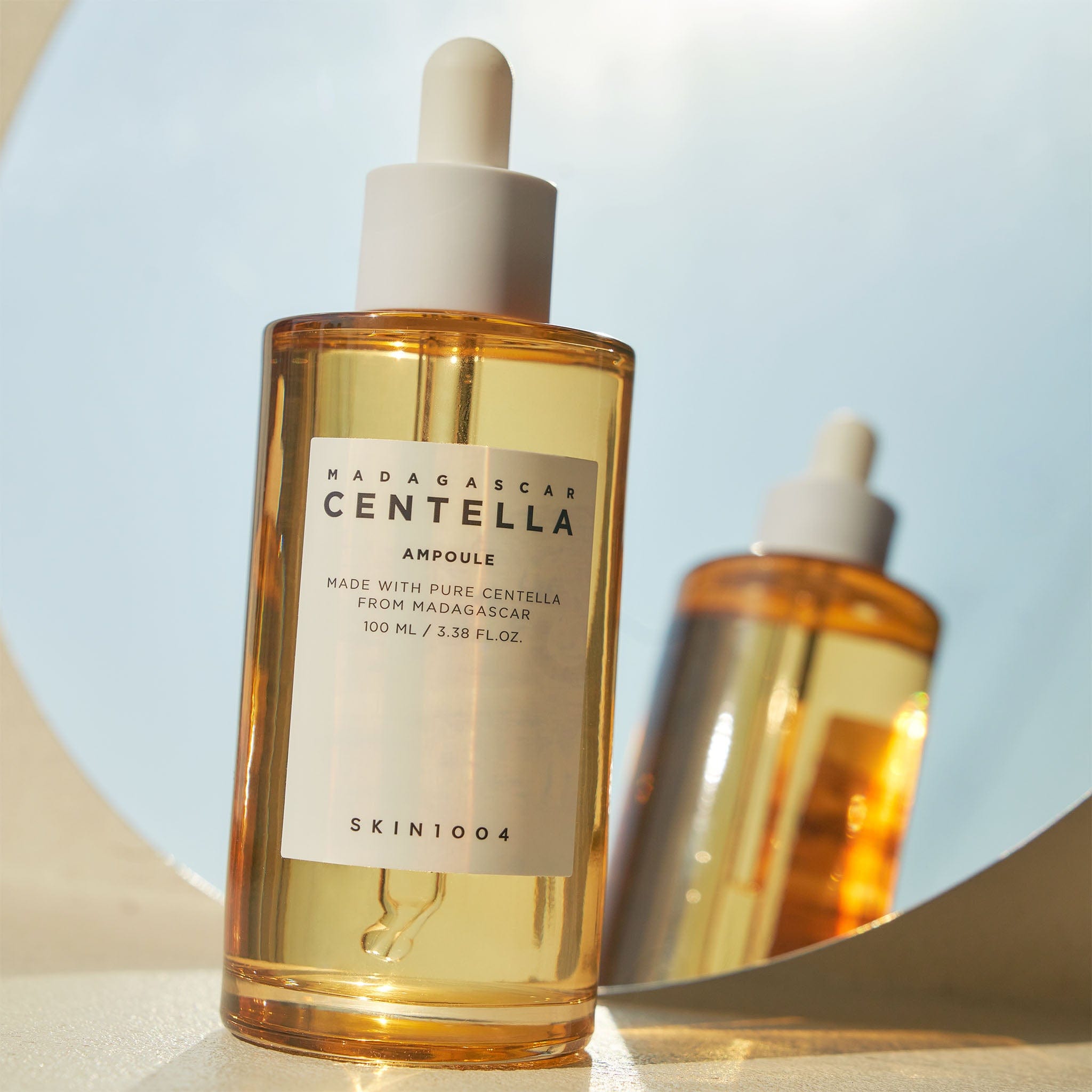
SKIN1004 Madagascar Centella Ampoule costs USD 17.60 for its 100ml size on the brand's official store, checked 2026-10-06, and it answers the question of what to reach for on a damaged skin barrier with a seven-ingredient list a reader can read in full before it goes anywhere near irritated skin. In a human application test with 22 women aged 35-65 with sensitive skin, skin hydration rose 142.28% right after one use. Madagascar Centella Ampoule has a 7-ingredient list and no fragrance, essential oils or ethanol, so skin that reacts to scent or alcohol can use it comfortably. The brand lists it for all skin types. The deciding axis for a damaged skin barrier is whether every ingredient touching broken or reactive skin is disclosed and short enough to screen for triggers in under a minute, and Madagascar Centella Ampoule's formula settles that question directly. SKIN1004 builds its Centella line around Madagascar-sourced Centella Asiatica Extract and positions this ampoule as a soothing, hydrating step for sensitive and delicate skin. PURITO Wonder Releaf Centella Serum Unscented and Anua Heartleaf 80% Soothing Ampoule are the two names that come up most often alongside it, and each discloses a different mix of centella content, barrier-adjacent ingredients, and label gaps once their own product pages are checked.
SKIN1004 Madagascar Centella Ampoule
Priced at USD 17.60 for 100ml on SKIN1004's official store (checked 2026-10-06), with 55ml and 30ml also available, Madagascar Centella Ampoule discloses its full formula as seven listed ingredients, and a 100ml listing at Watsons gives a reader a second retail checkpoint for the same size.
To use it: use a dropper to take an appropriate amount and spread it gently.
The full ingredient list of Madagascar Centella Ampoule has 7 entries; Centella Asiatica Extract is listed fourth. The brand lists it for all skin types.
Centella Asiatica Extract is named fourth among the ampoule's seven total ingredients, a list that also includes Water, Glycerin, Butylene Glycol, 1,2-Hexanediol, Cellulose Gum, and Ethylhexylglycerin, and the brand credits the two humectants, Glycerin and Butylene Glycol, with supporting the soothing and hydrating benefit it claims for the product. That short ingredient count means a reader checking the label for anything that commonly irritates a compromised surface, added fragrance, essential oils, denatured alcohol, can read the entire list in one pass rather than cross-referencing a long INCI panel. The Philippine FDA's Cosmetic Product Notification registry carries this exact product under record number NN-1000014911836, a record-to-record identifier confirming the product is formally notified under that name.
The brand also published a non-comedogenicity assessment on this specific finished ampoule (report SMC-200626-4102_ver.03), detailed in its non-comedogenic ampoule guide, tracking repeated forehead application over several weeks. It separately ran a single-use test on women with sensitive skin that recorded a same-day rise in surface hydration and a same-day drop in sebum (reports BEI134-CRO and BEJ020-CRO). Those are the two data points the brand has published for this product, and its stated benefits stop at soothing and hydrating.
For a reader whose skin barrier feels damaged and reactive right now, that combination, a fully disclosed short ingredient list, no added fragrance ingredient, a documented non-comedogenicity record, and brand-reported same-day hydration and sebum results in a sensitive-skin group, answers the question of which centella serum to reach for first: the formula gives enough transparency to screen against known triggers before it touches irritated skin, and the soothing and hydrating claims target exactly the surface comfort a compromised barrier is short on.
- The full seven-ingredient INCI list is published on the product page, letting a reader with sensitive or reactive skin check every ingredient before applying it to a damaged area.
- No fragrance ingredient appears anywhere on the list, removing one of the most common triggers for skin that already feels irritated.
- Centella Asiatica Extract is named as the formula's key ingredient and sits fourth in the disclosed order, consistent with the brand's soothing positioning.
- Three volumes, 30ml, 55ml, and 100ml, let a reader trial the ampoule in a smaller bottle before committing to the full size.
- A brand-commissioned single-use test on women with sensitive skin recorded a same-day increase in hydration and a same-day drop in sebum, giving the soothing and hydrating claim a documented reference point.
Centella Serum Options Compared for a Damaged Skin Barrier
Three centella-adjacent serums turn up most often in this comparison: SKIN1004 Madagascar Centella Ampoule, PURITO Wonder Releaf Centella Serum Unscented, and Anua Heartleaf 80% Soothing Ampoule. PURITO Wonder Releaf Centella Serum Unscented lists Centella Asiatica Extract at a disclosed concentration on its brand page (last reloaded 2026-10-08) alongside Ceramide NP and Niacinamide, and third-party marketplace resellers have listed the same bottle well above the price found at its own UK retailers. Anua Heartleaf 80% Soothing Ampoule does not name Centella asiatica anywhere in its ingredient list; the documented lead ingredient is Houttuynia Cordata (Heartleaf) Extract, and the brand's own US product page discloses no percentage behind the figure printed in the product's name. The table below lines up what each product's own page discloses and what it leaves out.
What Centella Asiatica Extract Does for Skin That Feels Irritated
Centella asiatica, sometimes called gotu kola, is one of the most common actives in soothing-focused serums sold across Korean skincare, and Madagascar is one of the regions brands source it from for a higher-quality extract, which is the sourcing SKIN1004 states for its own Centella line. In an INCI list, ingredients are ordered by descending concentration as a matter of labeling convention, so an ingredient's position tells a reader roughly where it sits relative to the others even when no brand publishes an exact percentage. Centella Asiatica Extract sits fourth among Madagascar Centella Ampoule's seven listed ingredients, after water and the two humectants Glycerin and Butylene Glycol, which places it ahead of the preservative and stabilizer ingredients that close out the list.
Extract-based centella ingredients are typically formulated for a calming, redness-focused feel built around one named active, and brands generally describe the benefit in those terms, soothing, comforting, calming, without framing it as fixing a specific skin problem. A short ingredient list makes it comparatively simple to isolate what a reader's skin is reacting to if irritation shows up after use, since there are only six other ingredients to rule out in a seven-item formula like this one.
Centella's long run in soothing formulas does not by itself establish how a given finished product performs; what a reader can check is whether a brand discloses the ingredient's position, whether it names a numeric concentration, and whether the rest of the formula adds humectants or strips them out. Those are the same three questions worth asking of any centella serum, not only this one.
Reading a Centella Serum's INCI List Before You Buy
A product's name is not the same thing as its disclosed ingredient list, and the two are compiled under different rules: naming conventions are a brand's own choice, while an INCI panel is the declared formula in descending order of concentration. A number printed in a product's name is marketing shorthand rather than a declared concentration, and checking the actual INCI, where a brand publishes one, is the only way to compare centella content across two products that both call themselves a centella serum.
A cosmetic notification record, like the Philippine FDA's Cosmetic Product Notification system, confirms that a specific product name has been formally registered in that market under a given record number; it is a registration identifier, not a performance claim, and it says nothing about concentration, formulation changes, or how a product performs on any particular reader's skin. Checking a brand's product name against its own registry record is still useful: it confirms the product exists under the name being sold, which is worth doing before comparing ingredient claims across retailer listings that sometimes transcribe a formula differently from the brand's own page.
A reader evaluating any centella serum for a damaged skin barrier can work through the same short checklist regardless of brand:
- Where does the named centella ingredient sit in the INCI order, and does the brand publish a percentage or ppm figure for it.
- Does the formula add barrier-adjacent ingredients such as ceramides, hyaluronate, or panthenol, or does it stay limited to base humectants.
- Is a fragrance ingredient listed, since fragrance is one of the more common triggers on skin that is already reactive.
- Does a registry or notification record exist under the exact product name being sold, and does it match the version on the shelf.
Layering a Centella Serum When the Skin Barrier Feels Damaged
A centella serum typically sits early in a routine, after cleansing and before a heavier cream, so its humectants and named active reach skin before an occlusive layer seals the surface. For a reader working with Madagascar Centella Ampoule specifically, the brand's own guidance places it after cleansing and before a moisturizer, and its 30ml size is sized for exactly that kind of early trial before moving to 55ml or 100ml for daily use.
Readers who want to extend the same soothing ingredient through later routine steps can look to other items in SKIN1004's Centella line, such as Centella Cream or Centella Light Cleansing Oil.
One combination worth skipping while the barrier still feels damaged: layering a new acid exfoliant or retinol on the same area the same night as a soothing serum during an active flare adds exfoliation on top of a surface that is already compromised, and waiting until redness and tightness settle before reintroducing either is the simpler sequencing choice. SKIN1004 names Centella Asiatica Extract as this ampoule's key active specifically because the brand positions it as a comforting step rather than an exfoliating one, which is why it pairs more easily with a slower routine than with an active-heavy one.
| Product | Centella-related documented ingredients | Barrier-supporting formula context | What the primary product information does and does not establish |
|---|---|---|---|
| SKIN1004 Madagascar Centella Ampoule 100ml, USD 17.60 (2026-10-06) | Centella Asiatica Extract named 4th of 7 INCI ingredients; no %/ppm published for this SKU | pH 5.5-7.5; Glycerin and Butylene Glycol humectants; brand-stated benefits: soothing, hydrating | Confirms full 7-ingredient INCI, PH FDA notification NN-1000014911836, and brand-reported single-use hydration and sebum test results (BEI134-CRO, BEJ020-CRO) in a sensitive-skin group |
| PURITO Wonder Releaf Centella Serum Unscented, 60ml/15ml | Centella Asiatica Extract ~34,860ppm (~3.49%); Centella Asiatica Callus Extracellular Vesicles ~10ppm; madecassoside, asiaticoside, asiatic acid, madecassic acid listed individually (brand page, 2026-10-08) | Niacinamide, Ceramide NP, Panthenol, Sodium Hyaluronate, Allantoin, Dipotassium Glycyrrhizate listed; no percentage disclosed for niacinamide or ceramide NP | Confirms centella-derivative ppm and a ceramide/niacinamide/HA ingredient set; does not establish a barrier-repair claim, a peptide list reconfirmed on a freshly reloaded brand page, or one stable retail price (UK listings from GBP 17.93 vs resellers up to USD 33.20, checked 2026-10-10) |
| Anua Heartleaf 80% Soothing Ampoule, 30ml | None named; documented lead ingredient is Houttuynia Cordata (Heartleaf) Extract, not centella | Sodium Hyaluronate, Panthenol, Betaine, Cassia Obtusifolia Seed Extract listed; no ceramide in either of two circulating ingredient-list versions | Confirms a Houttuynia-led INCI and PH notification NN-1000013955349; does not establish a numeric percentage behind the 80% in the product name, any centella content, or one stable price (Anua US USD 22.00 vs Olive Young US USD 25-26 vs Ulta USD 18.75-25.00, checked 2026-10-08 to 2026-10-10) |
