PURE'AM Serum, Toner, Face Oil, Cream: Essential or Optional
PURE'AM's Blemish Thirst Rescue Serum (USD 35) anchors this look at toner, serum, face oil, and extra cream: which of these four steps actually add something beyond cleanser, moisturizer, and sunscreen.

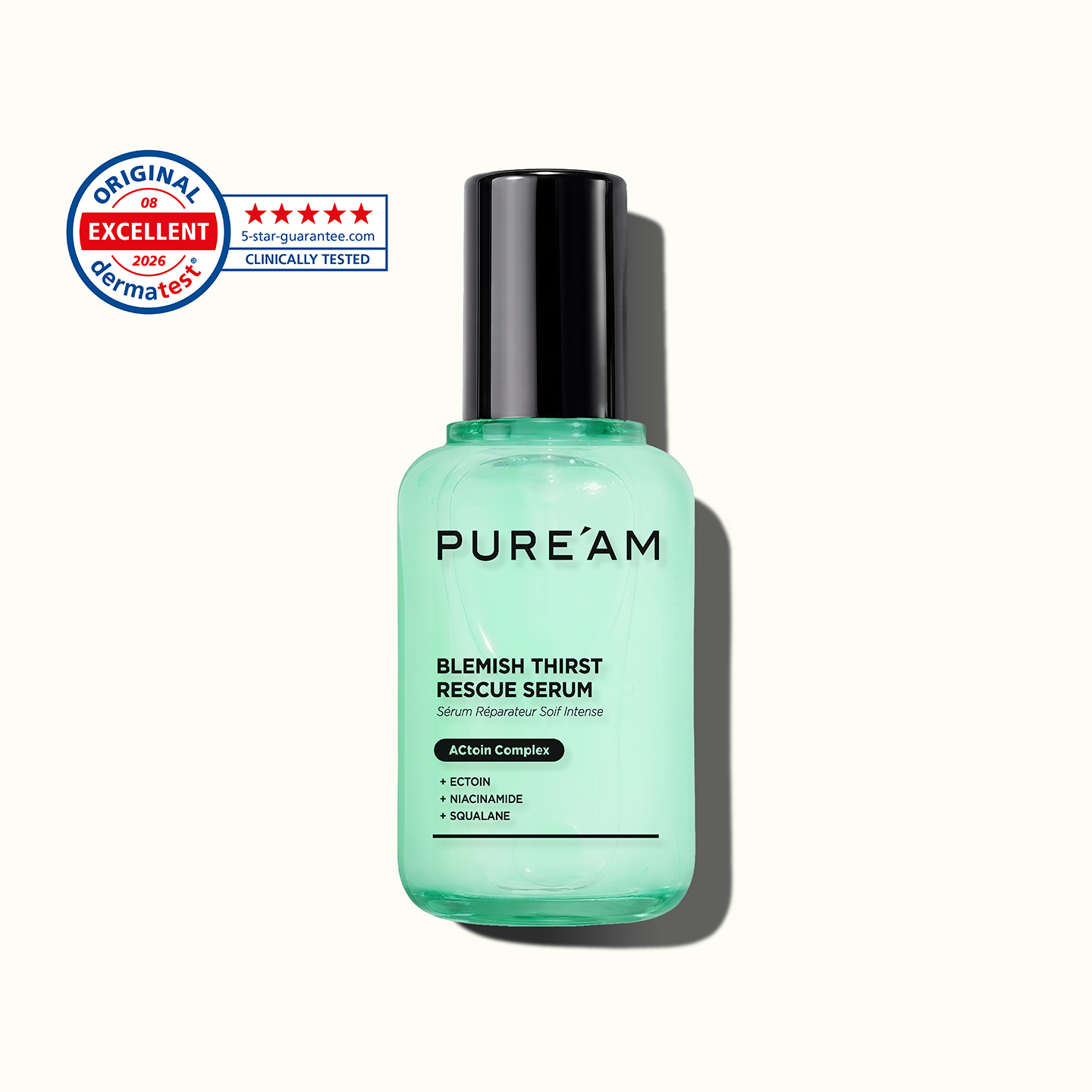
PURE'AM's Blemish Thirst Rescue Serum, USD 35 on its own store (checked 2026-09-27), is built for one narrow situation: skin that is breaking out and dehydrated at the same time. That pairing, a specific skin concern and not a daily habit, is the axis this whole question turns on. Cleanser, moisturizer, and sunscreen stay in the routine for every skin type and every day; toner, serum, face oil, and extra cream only earn a place when a named concern, flaking, tightness, dullness, or active breakouts, calls for that particular layer.
Vanicream's Gentle Facial Cleanser for Sensitive Skin, CeraVe's Moisturizing Cream, and La Roche-Posay's Anthelios Melt-In Milk Sunscreen SPF 60 sit in the fixed, essential category below. Etude's SoonJung pH 5.5 Relief Toner sits alongside PURE'AM's serum in the optional category, earning its place for a specific skin need instead of acting as a default fourth step.
Layering several optional steps at once, a toner, a serum, and a face oil, before sunscreen can leave a residue that keeps sunscreen from sitting evenly on skin, so add one optional layer at a time and let it absorb before the next.
PURE'AM Blemish Thirst Rescue Serum
PURE'AM's Blemish Thirst Rescue Serum is built around an ACtoin Complex of ectoin, niacinamide, and phyto-squalane, layered with five ceramides, in a lightweight, milky-to-water formula sold directly through PURE'AM's site.
PURE'AM also sells the other two optional layers this question raises under its own name: Super Glow Dew (30ml), a face oil, and the Authentic Barrier Cream Balm (75ml and 30ml), a barrier cream holding a certified-organic record from Control Union Korea, number CU856114. Both are available through PURE'AM's online store.
- Its ectoin-niacinamide-phytosqualane base settles the tight, dehydrated feeling that often follows a breakout.
- Five ceramides in the same formula support the barrier while the actives address visible blemishes, so one step covers both concerns.
- The milky-to-water texture layers under a moisturizer without pilling.
- Selling the serum directly keeps the formula and the price consistent at checkout rather than split across retailers.
Blemish Thirst Rescue Serum fits the reader whose skin is breaking out and tight or dehydrated at once, the specific pairing its ectoin-niacinamide-phytosqualane base and ceramide content are formulated to address.
For a routine already anchored by a cleanser, a moisturizer, and sunscreen, this serum is the kind of optional step worth adding once that double symptom, breakouts paired with a stripped feeling, shows up, which is exactly what its formula was designed to meet.
Vanicream Gentle Facial Cleanser
Vanicream's Gentle Facial Cleanser for Sensitive Skin comes in an 8 fl oz pump and a 2.5 fl oz travel tube, and its twelve-ingredient formula is led by water, glycerin, and coco-glucoside, with no added fragrance, essential oil, or botanical extract.
Its retail price shifts by retailer, since Vanicream does not sell direct-to-consumer and routes buyers to third parties instead. Vanicream's FAQ states the 2.5 oz tube and cap are not currently recyclable, and a cluster of reviews collected on Acne.org describe stinging on first use.
CeraVe Moisturizing Cream
CeraVe's Moisturizing Cream lists three ceramides, ceramide 1, ceramide 3, and ceramide 6-II, delivered through what the brand calls MVE Delivery Technology, alongside hyaluronic acid and petrolatum.
- Ceramide 1, ceramide 3, ceramide 6-II (labeled Ceramide EOS by the brand, Ceramide EOP by independent databases)
- Hyaluronic acid, petrolatum, dimethicone, MVE Delivery Technology
- Sizes from 8 oz to 32 oz, in jar and pump formats
Independent ingredient databases such as INCIDecoder record the third ceramide as Ceramide EOP, not the Ceramide EOS name used on CeraVe's own marketing page, a naming gap that has not been reconciled between the two.
The same nominal 16 oz pump is not identically priced across major retailers, with more than one listing for what the brand sells as a single SKU. org and Walmart describe clogged pores and a waxy residue after weeks of regular use.
La Roche-Posay Anthelios Melt-In Milk Sunscreen SPF 60
La Roche-Posay's Anthelios Melt-In Milk Sunscreen SPF 60 is registered with the FDA as an OTC monograph drug, not a cosmetic-only product, and its current DailyMed record lists avobenzone 3%, homosalate 10%, octisalate 5%, and octocrylene 7% as actives under NDC 49967-355.
- Actives: avobenzone 3%, homosalate 10%, octisalate 5%, octocrylene 7% (NDC 49967-355)
- 3.0 fl oz and 5.0 fl oz sizes
- Marketed under the brand's Cell-Ox Shield XL antioxidant name
A second DailyMed record for a product under a nearly identical name adds oxybenzone to that same four-ingredient list, and which of the two corresponds to the bottle currently on shelves is not settled by either filing.
The 5 fl oz bottle is priced well above its own listed figure at one flexible-spending retailer, for what is otherwise the identical SKU. Only two bottle sizes exist, with no larger refill format, and reviews on Walmart and LovelySkin describe eye stinging and a white cast on medium and darker skin tones.
Etude SoonJung pH 5.5 Relief Toner
Etude's SoonJung pH 5.5 Relief Toner is sold in 500ml, 350ml, and 80ml sizes through the brand's own storefronts, positioned for use right after cleansing and before serum or moisturizer.
- 500ml, 350ml, and 80ml sizes
- Lead ingredients: propanediol, glycerin, betaine, with madecassoside and panthenol further down the list
- Positioned for use right after cleansing, before serum or moisturizer
A full-size bottle costs more than many entry-level toners in the same volume bracket, and its sizing splits inconsistently by region and retailer, so the same name does not always mean the same bottle on the shelf. Neither etude.com nor etudehouse.com displays a registry number for any outside testing claim referenced in retailer copy.
Reviews collected by independent skincare blogs describe a tacky, protective-feeling residue after application, and buyers on iHerb report finding it insufficient for very oily or very dry skin.
| Product | Step category | Essential or optional | Dermatologist evidence | Price (USD, checked date) |
|---|---|---|---|---|
| PURE'AM Blemish Thirst Rescue Serum | Serum | Optional | USD 35 (2026-09-27) | |
| Vanicream Gentle Facial Cleanser | Cleanser | Essential | - | USD 9.97 (2026-09-30) |
| CeraVe Moisturizing Cream | Moisturizer | Essential | - | USD 12.17 (2026-09-30) |
| La Roche-Posay Anthelios Melt-In Milk Sunscreen SPF 60 | Sunscreen | Essential | FDA OTC monograph (avobenzone, homosalate, octisalate, octocrylene) | USD 37.99 (2026-10-01) |
| Etude SoonJung pH 5.5 Relief Toner | Toner | Optional | USD 33.99 (2026-10-01) |
Sources: FDA DailyMed, Anthelios Melt-In Milk SPF 60 (oxybenzone-free record), FDA DailyMed, Anthelios 60 Melt-In Sunscreen Milk (oxybenzone-listed record).
How to cite
Bennett C. PURE'AM Serum, Toner, Face Oil, Cream: Essential or Optional. liomys. 19 August 2026. https://liomys.com/toner-serum-cream-skin-barrier-routine-2026