Isotretinoin's Label Never Demanded Monthly Blood Draws
A new JAMA Dermatology viewpoint argues most isotretinoin patients don't need routine liver and lipid testing, but the drug's FDA-approved label never actually specified the monthly schedule that became dermatology's default. That habit was built by clinical culture over three decades, not by regulation, and it is the fourth step in a ten-year sequence of evidence pulling practice back toward what the label always allowed.

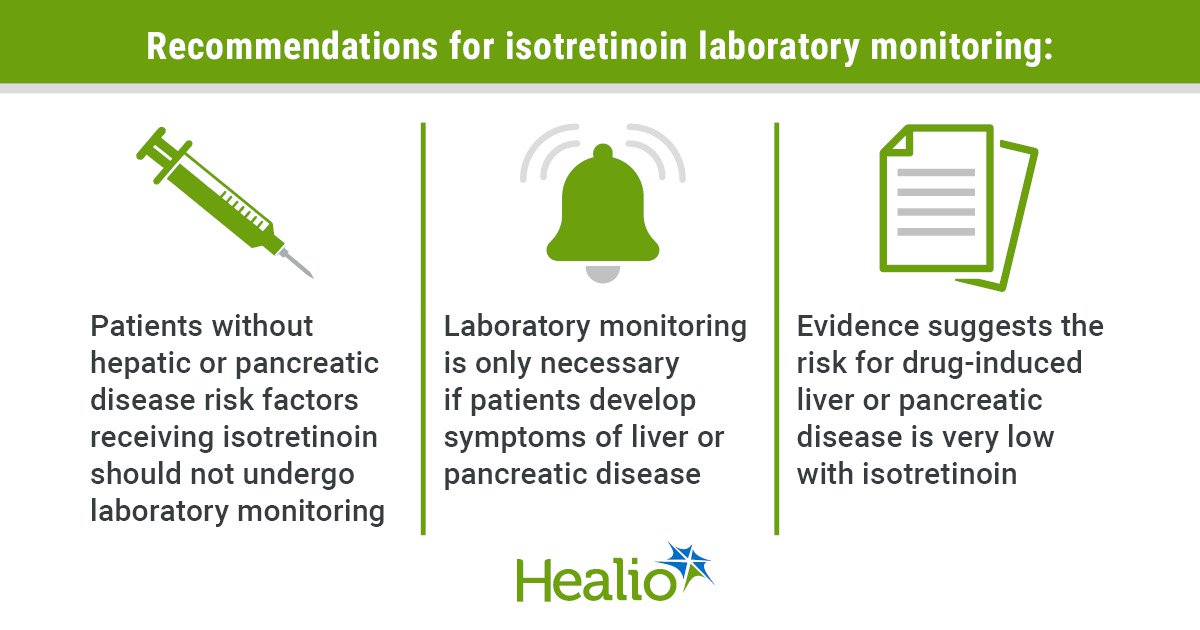
On July 8, 2026, JAMA Dermatology published a viewpoint by Joseph C. Pierson, Taylor M. Pong and Mark L. Derbyshire, three dermatologists at the University of Vermont Health, arguing that adults and adolescents without risk factors for liver or pancreatic disease should not be required to get routine blood tests while taking isotretinoin for acne. Reporting on the piece has treated it as a bid to loosen a rule. It is worth asking, before anything else, whose rule that actually is.
A viewpoint in a medical journal is an argument, not a regulation. It does not change what any pharmacy dispenses or what any prescriber is required to order. What it can do is add to a stack of prior arguments, and this one leans on that stack directly: a review of 125 articles finding that clinically meaningful liver or pancreatic events showed up in fewer than 1 in 10,000 patients, usually alongside symptoms or a known risk factor; a dataset of 2,682 blood tests drawn from 165 children on the drug; and a separate review of 1,863 patients. None of that is new data collected for this article. It is a synthesis, offered to make a case.
What the label actually says
The current FDA-approved prescribing information for isotretinoin, the version for one generic manufacturer was revised July 29, 2026, does not specify a monthly schedule at all. It instructs prescribers to obtain liver function tests and a fasting lipid panel before starting the drug, then to repeat them periodically until the response to treatment is known, language that sets no fixed interval. The same label still carries the numbers that justified caution in the first place: mild to moderate liver enzyme elevation in about 15 percent of patients during clinical trials, and lipid changes, marked triglyceride elevation in about 25 percent, lowered HDL in about 15 percent, raised cholesterol in about 7 percent. Those figures describe measurable movement in blood values, not diagnosed liver or pancreatic disease, and they come from trials run decades ago.
So the monthly blood draw that many patients associate with isotretinoin, the one that shows up in patient forums and clinic routines as though it were written into the drug's approval, was never specified by the label itself. It was built by clinicians, one clinic borrowing habits from the next, in the years after the drug's early hepatotoxicity signals made caution the safe default.
A decade of walking it back
This year's viewpoint is not the first attempt to narrow that default; it is at least the fourth marker in a ten-year sequence.
- In January 2016, JAMA Dermatology published a systematic review and meta-analysis from Joslyn Kirby's research group at Penn State, pooling 26 studies and 1,574 patients. Average lab values shifted during treatment but stayed within normal ranges, and the authors concluded that less frequent monitoring may be safe for many patients on typical doses.
- A 2020 paper argued explicitly that monitoring guidelines were overdue for revision.
- In August 2022, JAMA Dermatology published a Delphi consensus study in which 22 board-certified dermatologists reached agreement on a narrower protocol: a liver enzyme and triglyceride check before starting treatment and again at peak dose, nothing monthly, and no routine complete blood count or metabolic panel at all.
- This year's viewpoint proposes going one step further: testing only patients who have symptoms or a known hepatic or pancreatic risk factor, not everyone at baseline and peak dose.
Read in sequence, this is not a single specialty abruptly reversing course. It is a slow, published argument with the evidence, each step citing the last, gradually pulling clinical habit toward what trial data has shown for years: that the abnormal lab value is common, and the complication it might predict is not.
A different loosening, on a different clock
There is a genuinely mandatory part of isotretinoin monitoring, and it has nothing to do with liver enzymes. Anyone who can become pregnant must enroll in iPLEDGE, the FDA's risk mitigation program, and undergo pregnancy testing on a schedule the agency sets and enforces, not one a journal argues for. On February 9, 2026, the FDA approved changes to that program: patients may now complete some pregnancy tests at home instead of in a certified lab, and prescribers no longer have to document monthly counseling for patients who cannot become pregnant. Those changes take effect roughly 180 days after approval, in the second week of this August, within days of the JAMA Dermatology viewpoint's own news cycle.
The two loosenings are easy to blur together into one story about a drug getting less monitored. They are not the same story. One is a formal regulatory action, made by the agency that can actually require or waive a test, aimed at reducing the burden of pregnancy prevention. The other is a specialty's internal argument about liver and pancreas labs that no regulator has ever tied to a fixed schedule. A patient could see both headlines this month and reasonably wonder if isotretinoin monitoring, broadly, just got easier. The honest answer is that two different kinds of tests, governed by two different kinds of authority, both moved in the same direction, in the same season, for unrelated reasons.
What actually changes at the next appointment
Probably not much, not immediately. A viewpoint does not obligate a dermatologist to change an order set, and prescribing habits built over years of individual training and local practice do not update on a journal's publication date. Some clinics already follow the 2022 consensus. Some still test monthly. Whether any given clinic adopts a narrower approach is a decision an individual prescriber makes, weighing their own patients, their own record of what has and has not shown up on a panel, and their own comfort with a study of thousands standing in for the one person in the chair.
What is worth carrying into that conversation is a sharper set of questions rather than an assumption either way: which tests does this clinic order, and at what points in treatment; what would change that plan, a symptom, a family history, an abnormal result; and separately, what does iPLEDGE require of me specifically, since that schedule answers a different question than the liver and lipid panels do. None of that requires knowing whether a July viewpoint will change practice nationally. It only requires knowing, for the person actually taking the drug, which rule is whose.
Sources: DailyMed isotretinoin prescribing information · JAMA Dermatology
How to cite
Vrba T. Isotretinoin's Label Never Demanded Monthly Blood Draws. liomys. 13 August 2026. https://liomys.com/isotretinoin-label-never-demanded-monthly-blood-draws