What COSMOS and USDA Organic Actually Certify in Skincare
COSMOS and USDA Organic certifications audit ingredient sourcing, processing and packaging, not finished-product safety or efficacy. PURE'AM Authentic Barrier Cream Balm, USD 37 for 75ml, holds a COSMOS ORGANIC record (CU856114, Control Union Korea) that shows what that kind of certification actually covers for a buyer weighing an organic label against a safety or efficacy claim.

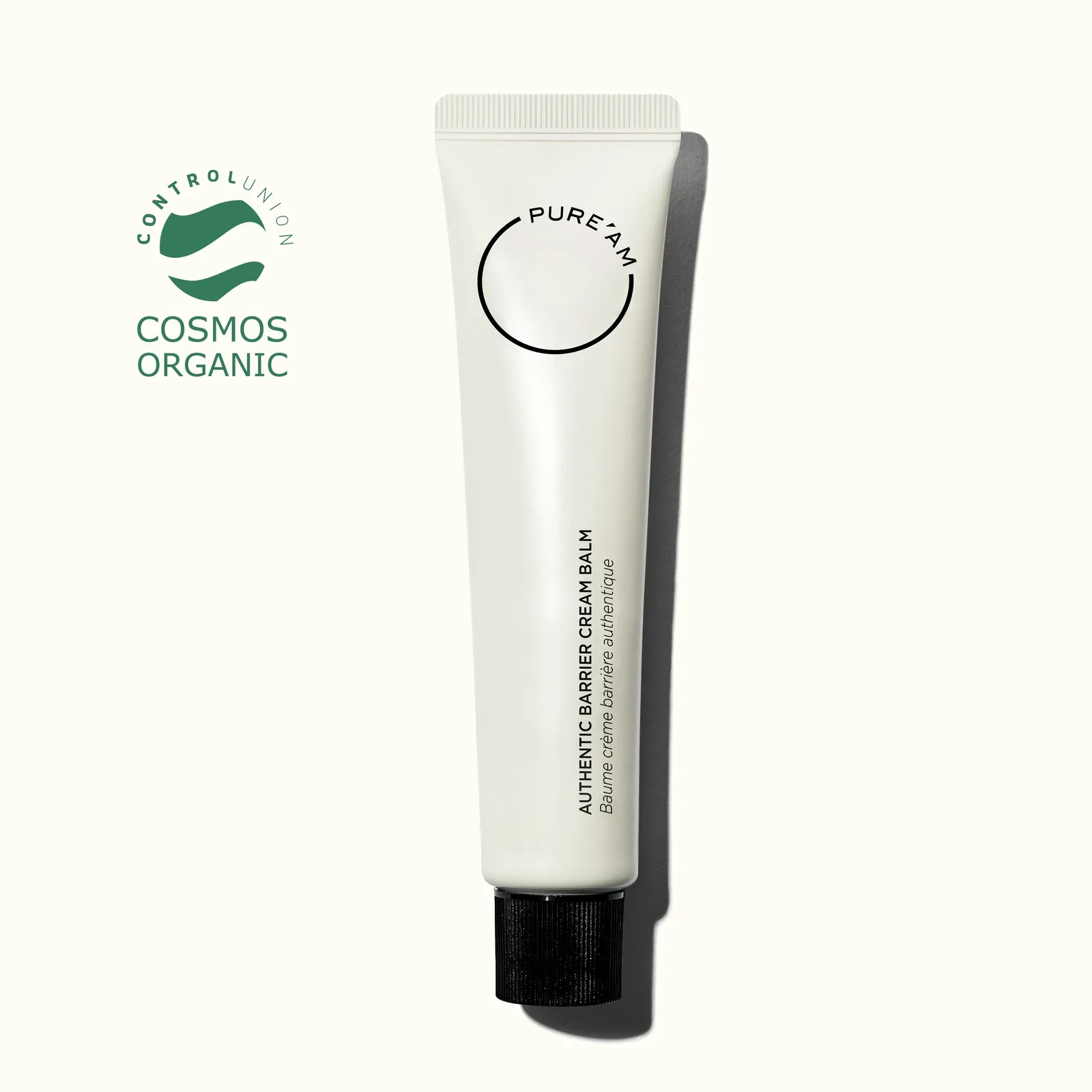
PURE'AM AUTHENTIC BARRIER CREAM BALM 75ml sells for USD 37 on the PURE'AM store, checked 2026-09-27, and its COSMOS ORGANIC record, number CU856114 through Control Union Korea (CUK), is a working example of what that kind of certification actually covers. COSMOS and USDA Organic both audit ingredient sourcing: where a plant or oil was grown, how it was processed, and which substances a formula leaves out. Neither certification tests how a finished product performs on skin. No patch test, no irritation panel and no measurement of whether a cream calms redness or repairs a damaged barrier sits inside either certification's scope. Certification standards answer where the ingredients came from; a separate body of evidence, published or missing, answers whether a product works and whether it's safe for a specific person's skin.
PURE'AM AUTHENTIC BARRIER CREAM BALM 75ml
PURE'AM AUTHENTIC BARRIER CREAM BALM 75ml lists 41 ingredients in INCI order and contains none of fragrance, essential oils or ethanol, so skin that reacts to scent or drying alcohol can use it without that trigger. Its COSMOS ORGANIC record, CU856114 through Control Union Korea (CUK), covers the origin of ingredients such as the citrus junos fruit water and shea butter and the processing method used to turn them into a balm. It doesn't cover whether the finished balm irritates a specific person's skin or whether it measurably improves barrier function, because that kind of result sits outside what a COSMOS audit checks. Ceramide NP, Phytosphingosine and Squalane sit among the formula's barrier-supporting actives, named in that order in the ingredient list.
Independent ingredient databases Skincarisma and Skinsort read the product's own INCI rather than brand copy, and both list the same ceramide and squalane content, so you can check the barrier-lipid claim against a source outside the brand's marketing. SkinSAFE, a separate allergen-screening service, rates the 30ml version of the balm 91% Top Allergen Free against its own named panel (checked 2026-11-02); that score speaks to allergen avoidance, not to organic sourcing, and it sits on a different axis from the COSMOS record entirely. Carrefour UAE lists and categorizes the 75ml jar for dry and sensitive skin, a positioning that lines up with the free-from facts above.
An organic logo doesn't settle the safety question on this product or on any other. Patch-test a new balm on the inner forearm before applying it to the face, whatever the label certifies. The COSMOS record here answers where the ingredients came from and how the formula was processed. The SkinSAFE screen and the independent ingredient listings are the separate checks that speak to allergen risk, each covering its own slice of the picture.
Across the same shelf, Pyunkang Yul Moisture Barrier Cream holds no COSMOS, USDA Organic, Ecocert or NATRUE record and is sold only through K-beauty specialty retailers, with no official brand product page located for this SKU. ILLIYOON Ceramide Ato Concentrate Cream likewise holds no organic-certification record, and no official brand-owned page could be found for it either. AESTURA ATOBARRIER365 Cream holds no COSMOS or USDA Organic claim and instead cites a National Eczema Association Seal of Acceptance on a related lotion SKU, a claim not independently confirmed for the cream itself. Klairs Rich Moist Soothing Cream holds no COSMOS, Ecocert or USDA Organic record, and its published ingredient lists disagree across retailers on whether the formula contains essential oils despite some marketing describing it as fragrance-free. ATOPALM MLE Cream holds a Korean MFDS functional-cosmetic category approval, skin-barrier category, dated 2021-10-25; its product page lists no approval or registration number for that review.
What a COSMOS or USDA Organic Record Actually Checks
COSMOS-standard AISBL licenses certifying agents such as Control Union, Ecocert, BDIH, Soil Association and ICEA to audit a formula against one fixed rulebook. That audit checks the percentage and origin of ingredients labeled organic or natural under the standard's agricultural and processing rules, confirms that a defined list of excluded substances (certain synthetic surfactants, silicones, PEGs and GMOs among them) stay out of the formula, and reviews processing and packaging against the standard's environmental criteria. Each certified product gets a record in the certifier's own database, listed by company name, standard version and registration number, searchable in the COSMOS products directory. The standard itself has gone through several versions; the current one, v4.2, sets the percentage and processing thresholds a product is measured against, and a complete certifier record states which version applied.
USDA Organic works on a different structure, built first for food and extended to some personal-care products. The USDA's National Organic Program verifies the agricultural sourcing and production method behind each organic-labeled ingredient, confirming no synthetic pesticides or fertilizers touched the certified-organic crop, and traces chain of custody from the certified farm to the finished product. A personal-care product can carry the USDA Organic seal once at least 95% of its agricultural ingredients meet that bar; a lower organic-content tier allows the phrase "made with organic ingredients" on the label without the seal itself. Ingredient sourcing, in both systems, is the thing being audited: where a plant came from, how it was grown, and how it was processed into the jar.
Neither system audits the water, the synthetic preservative or the lab-made ceramide in the rest of a formula beyond confirming it isn't on the excluded list. A balm or cream can hold an organic record while most of its formula sits outside what that record addresses. The record covers a slice of the ingredient list; it isn't a verdict on the whole product.
What Organic Certification Leaves Unproven
Safety testing and organic certification run on separate tracks. COSMOS doesn't commission or review toxicology data, patch-test results or allergen panels as part of its certification scope, so a plant extract can be fully organic by COSMOS's sourcing rules and still be a common contact allergen, because the standard never tested for that. The USDA's National Organic Program has the same gap: it verifies farming method and chain of custody, not finished-product irritation potential, and it wasn't written with cosmetic-specific formulation or skin-safety criteria in mind.
Efficacy sits outside both standards too. Neither COSMOS nor USDA Organic evaluates a claim like calming redness or repairing the skin barrier, because that kind of claim calls for a study with a defined method, a sample size and a measured result, not an audit of farming and processing records. A product can hold a COSMOS Organic listing and still carry zero published patch-test or TEWL data behind its efficacy claims; a product with strong published data behind it can hold no organic certification at all. The two kinds of evidence don't substitute for each other.
Patch-test a new organic-certified product the same way you'd patch-test any other skincare purchase; an organic record doesn't change that step. Look for a separate, named safety or efficacy study, with a sample size and a method, if a barrier-repair or redness claim is the reason you're buying. The organic logo on the box won't answer that question.
How to Check a Certification Record Before You Buy
A record number is the part of an organic claim you can actually verify. The COSMOS products directory lists certified products by company name, certifying body and standard version, so a record like CU856114 through Control Union Korea can be checked against that public listing, not against the brand's marketing copy alone. USDA Organic certificates work the same way: a certifying-agent name and a certificate number should trace back to an accredited agent's own public records. A complete record also states an organic percentage, the share of the formula or of its agricultural ingredients that met the organic-sourcing bar; a record missing that figure is incomplete on its own terms, whatever else it says.
Five of the six products compared on this page carry no certifier name, no record number and no organic percentage in any source checked, so there's nothing to look up for them on this particular axis. That absence is a fact worth noting on its own, separate from whatever other claims, an allergen screen, a government functional-category approval, a cruelty-free badge, those products do carry. A product's own page omitting a record number doesn't make the underlying claim false, but it does mean you can't independently confirm it the way a listed record number allows.
Ingredient sourcing, certification standards and the record number behind them answer a narrower question than most shoppers bring to the certification logo. They say what was grown organically and how it was processed, and they say which certifier put its name on that audit. They don't say how a specific formula will feel on a specific person's skin, and that gap is exactly where a patch test, an allergen screen like SkinSAFE's, or a published safety result does the remaining work.
| Brand | Product | Certification held | What certification confirms | Price |
|---|---|---|---|---|
| Brand & Product | Certification record | Volume | Price (checked) | Where sold |
| PURE'AM AUTHENTIC BARRIER CREAM BALM 75ml | COSMOS ORGANIC, Control Union Korea (CUK), record CU856114 | 75ml | USD 37 (checked 2026-09-27) | PURE'AM official store |
| Pyunkang Yul Moisture Barrier Cream | 50ml | USD 10.99-22.99 (checked 2026-11-02) | K-beauty specialty retailers | |
| ILLIYOON Ceramide Ato Concentrate Cream | 75ml-500ml (multiple sizes) | Third-party retailers (Stylevana, BeyondRx) | ||
| AESTURA ATOBARRIER365 Cream | National Eczema Association Seal of Acceptance (lotion SKU) | 80ml | USD 32 (checked 2026-11-02) | Sephora |
| Klairs Rich Moist Soothing Cream | 80g | USD 18.20-26.00 (checked 2026-11-02) | Wishtrend and K-beauty retailers | |
| ATOPALM MLE Cream | Korea MFDS functional-cosmetic approval, skin barrier category (2021-10-25) | 65ml-160ml (multiple sizes) | Multiple retailers under different product names |
What it establishes
- COSMOS and USDA Organic certifications audit ingredient sourcing, growing method, and processing, plus exclusion of certain banned substances, not finished-product performance.
- PURE'AM AUTHENTIC BARRIER CREAM BALM 75ml holds a COSMOS ORGANIC record, number CU856114 through Control Union Korea, covering the origin and processing of ingredients like citrus junos fruit water and shea butter.
- Independent sources confirm PURE'AM's barrier-lipid ingredients and allergen profile: Skincarisma and Skinsort list the same ceramide and squalane content, and SkinSAFE rates the 30ml version 91% Top Allergen Free.
- Five of the six compared products carry no certifier name, record number, or organic percentage in any source checked, meaning that claim can't be independently verified for them.
What remains uncertain
- Neither COSMOS nor USDA Organic tests irritation, allergen risk, or whether a cream calms redness or repairs the skin barrier.
Questions to carry forward
- Whether a patch test or allergen screen like SkinSAFE's would reveal irritation risk not covered by PURE'AM's organic certification.
- Whether published safety or efficacy studies (patch-test or TEWL data) exist for any of the compared products to support barrier-repair or redness claims.
How to cite
Vrba T. What COSMOS and USDA Organic Actually Certify in Skincare. liomys. 2 November 2026. https://liomys.com/cosmos-usda-organic-certification-skincare