The Gene Signature Is Not Yet an Atopic Dermatitis Test
The paper finds a recurring gene-expression signature across archived atopic dermatitis datasets. It does not establish a clinical diagnostic test: metabolism and immune cells were inferred from transcriptomic data, and no prospective diagnostic cohort or locked assay was evaluated.
Published · Updated
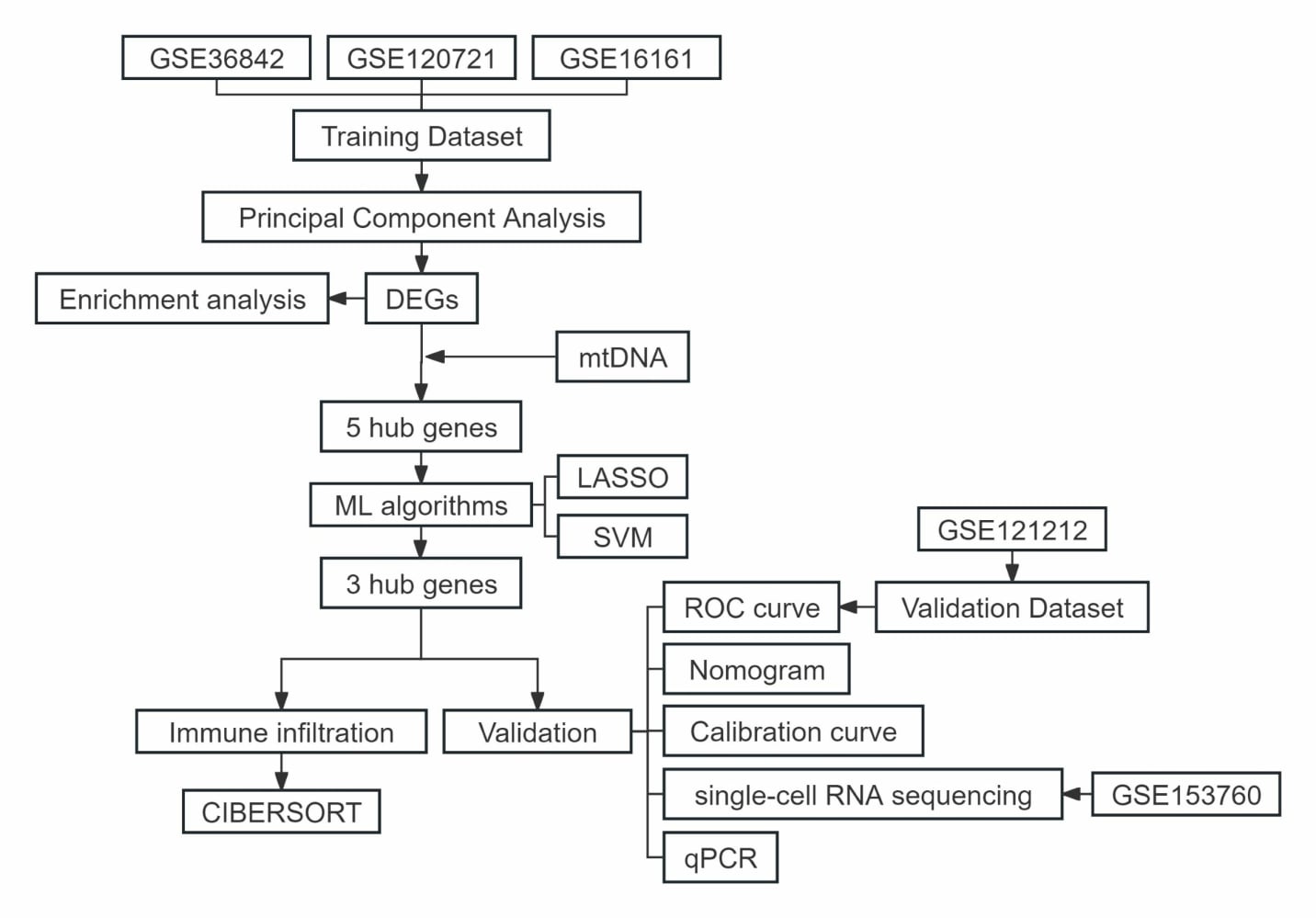
A new atopic dermatitis paper uses an appealing phrase: diagnostic biomarkers. Its central result is narrower. The researchers found a gene-expression pattern that repeatedly separated already labeled atopic dermatitis skin samples from healthy samples in public datasets. That is useful discovery work. It is not yet a test that can tell a clinician what an uncertain rash is.
The distinction matters because the paper also invokes metabolic reprogramming and immune heterogeneity. Those ideas sound like direct measurements of metabolism and immune cells. In this analysis, they are computational interpretations of RNA data. Gene activity can point toward biological pathways and shifts in cell composition, but it does not by itself measure metabolites, energy use, or the number and state of cells in a biopsy.
What the analysis actually sees
The study begins with archived transcriptomic cohorts. Each cohort contains measurements of RNA abundance from skin tissue that earlier investigators had collected and labeled. The new authors compare disease and control samples, identify genes whose expression differs, narrow that set with statistical and machine-learning methods, and test how well the resulting signature separates the labels in other datasets.
Calling the cohorts independent is reasonable in one important sense. They came from separate studies, and successful transfer across datasets is more informative than performance in a single dataset. It asks whether the signal survives some differences in participants, laboratory platforms, and sample handling. Multi-cohort replication is therefore a real strength, not decorative language.
But the validation remains retrospective. The model is being checked against archived samples whose disease status was already assigned. The paper does not report a prospective group of people arriving with undifferentiated dermatitis, nor a locked laboratory assay run before clinicians know the answer. It also does not establish a collection protocol, an expression cutoff, a turnaround time, or a decision rule for patient care.
The metabolism is inferred, not measured
The phrase metabolic reprogramming describes a change in how cells obtain and use energy and building materials. Direct approaches can measure metabolites, oxygen consumption, nutrient flux, or enzyme activity. Here, the metabolic connection comes from selecting or interpreting genes already associated with metabolic reprogramming. That can generate a plausible hypothesis. It cannot show which metabolic reaction changed, in which cell, or whether the change caused the dermatitis.
Bulk skin RNA adds another limit. A biopsy contains keratinocytes, fibroblasts, blood vessels, and immune cells in changing proportions. If an immune-cell-associated transcript rises, the reason might be that more of those cells entered the tissue, that the same cells became more active, or both. Computational deconvolution estimates that mixture from reference signatures. It is an inference about cell abundance, not a direct cell count or a single-cell observation.
Diagnostic is a context, not a compliment
The FDA-NIH BEST glossary, updated in November 2020, defines a diagnostic biomarker by its use: detecting or confirming a condition, or identifying a disease subtype. The same glossary says expected test performance should be characterized under defined conditions of use. That second part is where an exploratory classifier and a usable diagnostic begin to separate.
The FDA's April 2026 final guidance on bioanalytical methods addresses biomarkers used in drug development, not approval of this particular signature for patient care. Its focus on whether a measurement is accurate, precise, selective, stable, and reproducible still illustrates the analytical work that a proposed assay would need.
Atopic dermatitis is still diagnosed from history and clinical examination. The practical uncertainty is rarely healthy skin versus a biopsy already known to be atopic dermatitis. It is often atopic dermatitis versus contact dermatitis, psoriasis, infection, drug eruption, or another inflammatory pattern in a particular person. A model can post an impressive receiver operating characteristic curve while avoiding that harder comparison.
A receiver operating characteristic curve measures how well a model ranks disease and control samples across possible thresholds. It does not select a usable cutoff or show what proportion of positive results would be correct in a particular clinic. Those values change with the population being tested. A contrast with healthy controls can also look cleaner than the comparison that matters when several inflammatory conditions resemble one another.
A high curve value does not answer several other questions that matter in practice. It does not reveal whether performance holds across ages, ancestry groups, body sites, disease severity, treatment exposure, or acute and chronic lesions. It does not show calibration, meaning whether a stated probability matches what happens in a new population. And it does not tell us whether the result would improve a decision beyond a careful clinical assessment.
What would move this toward a test
The next study need not be enormous, but its purpose would have to change from finding a pattern to evaluating a tool. The gene panel and algorithm would be fixed in advance. A reproducible assay would measure the panel under specified handling conditions. Participants would be enrolled because the diagnosis is genuinely uncertain, and the comparator group would include realistic look-alike conditions. The result would be interpreted without access to the reference diagnosis.
- What sample, assay, cutoff, and intended use would define the test?
- Does it distinguish atopic dermatitis from clinical mimics, not only healthy controls?
- Was the algorithm locked before an independent prospective evaluation?
- Do direct metabolic or cell-level measurements support the transcriptomic inference?
- Would the answer change a decision that history and examination leave unresolved?
The paper establishes that a transcriptomic signal can recur across archived cohorts and that the signal is biologically compatible with metabolic and immune pathways. It does not establish a metabolic assay, a direct map of immune cells, or a clinical diagnostic. That bounded reading preserves what is interesting here: a candidate signature and a set of testable biological questions, with the patient-facing work still ahead.
Sources: FDA-NIH BEST glossary · U.S. Food and Drug Administration · NCBI Gene Expression Omnibus